Diary Study on Users' Interactions with AI Assistants
A mixed-method research study exploring how people actually use AI assistants like Siri, Alexa, and Google Assistant in everyday life.
Role: UX ResearcherTools: Google Docs, Google FormsTimeframe: 3 weeks
Overview
AI-powered personal assistants are increasingly embedded in daily life, but their usefulness still varies depending on context, expectations, and trust.
This study explored real-world interactions with AI assistants through diary entries and follow-up interviews to uncover what works, what frustrates users, and what people want improved.
Overview of the diary study research focus.
Research Objective
The core research question was: How do users engage with AI-powered personal assistants, and how do these interactions shape their experiences?
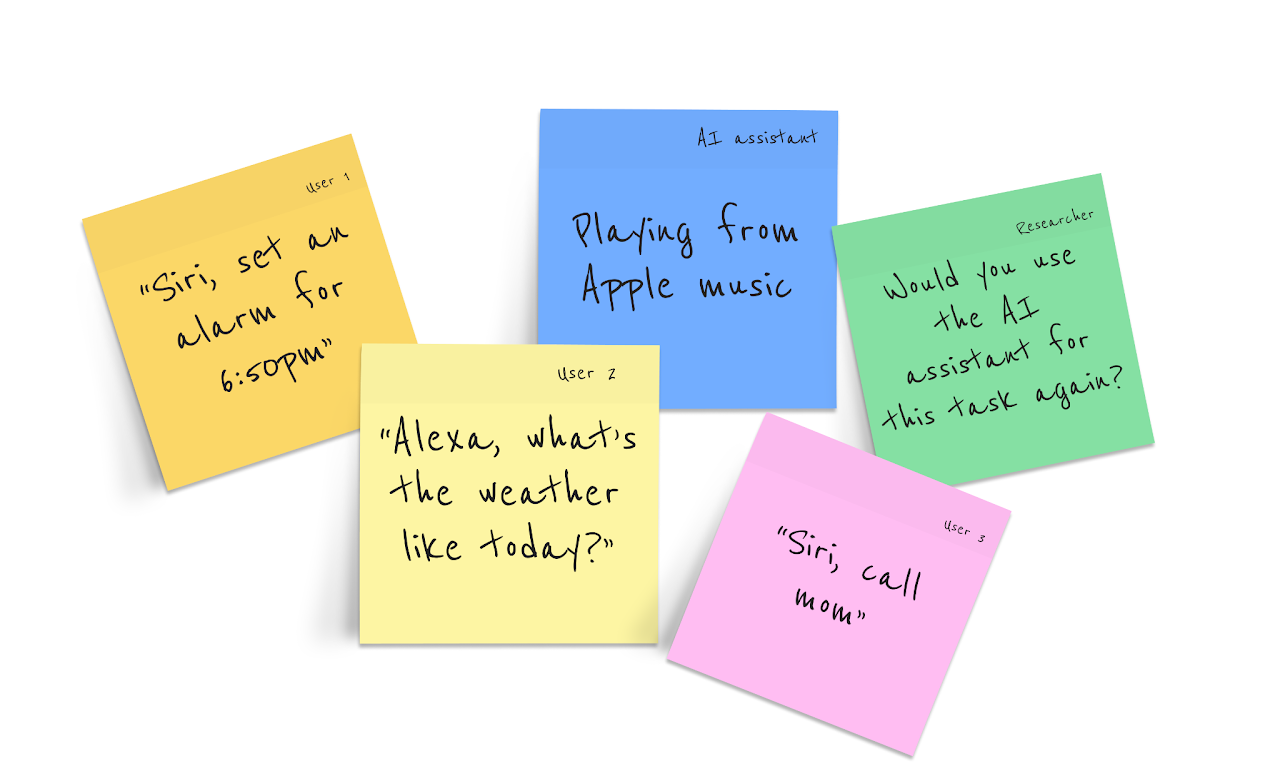
Participants documented their AI assistant usage over three days, noting what they used, what tasks they attempted, whether performance matched expectations, and whether they would rely on that assistant for the same task again.
Study Design
After the diary study, we conducted semi-structured interviews to expand on those diary entries and explore recurring concerns in more depth.
This combination gave us both real-time behavior and deeper reflection, which made the findings more grounded.
Research setup Participant selection, diary study, and follow-up interview methods.
Methods
1) Participant selection and diary study
We recruited individuals who frequently use AI assistants and asked them to log their experiences over three days through a digital form.
The diary entries captured recurring themes, usage patterns, and differences in how people relied on these tools.
Which AI assistant did you use today?
What task did you perform?
Did it meet your expectations?
Would you rely on it for that task again?
2) Follow-up interviews
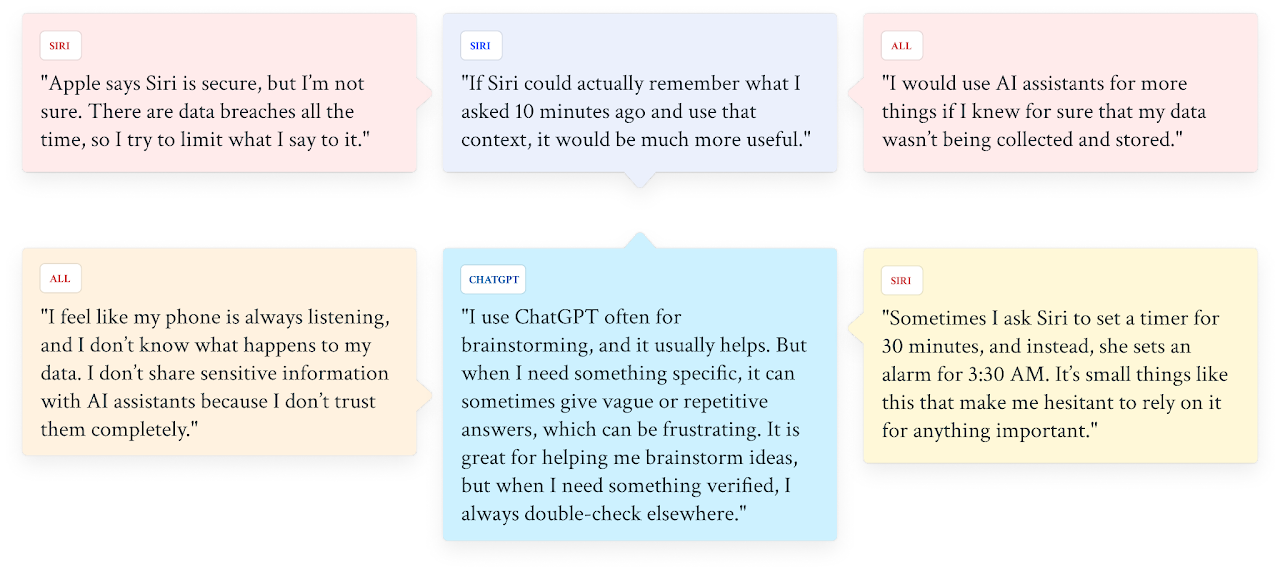
After the diary phase, we conducted one-on-one interviews to expand on diary responses, identify areas of satisfaction and frustration, and dig further into concerns about privacy and reliability.
This mixed-method approach allowed for a fuller understanding of how AI assistants fit into people’s routines.
Interview themes and clustered responses.
Key Findings
1) Convenient, but often inconsistent
Most participants found AI assistants helpful for simple tasks like reminders, music, and basic information. But they frequently ran into misinterpretations and inconsistent performance.
2) Privacy concerns shaped trust
A major theme was uncertainty about what AI assistants track and store. That uncertainty changed how much personal information people were willing to share.
3) Mostly used for low-stakes tasks
Participants overwhelmingly relied on AI assistants for routine, non-critical activities. They were hesitant to trust them for urgent or complex decisions because reliability still felt inconsistent.
4) Clear improvement requests emerged
Better context awareness across interactions.
More accurate and less repetitive responses.
Stronger privacy transparency.
Improved integration with other apps and devices.
Design Implications
Privacy controls should be surfaced at the point of data collection, not buried in settings.
Context persistence across sessions was the highest-impact improvement users requested. That should be a first design priority.
Study review Strengths, limitations, and what a future round should investigate.
Study Strengths
The diary study captured real-time, unfiltered experiences.
Interviews added deeper context and clarification.
The study surfaced both positive and negative aspects of AI assistant use.
Study Limitations
Some diary responses were too brief and needed follow-up probing.
Participants occasionally forgot to log interactions in real time.
The small sample size limits broad generalizability.
Future Considerations
Use structured reminders to encourage real-time logging.
Expand the participant pool for more diverse patterns.
Extend study duration to understand longer-term interactions.
Conclusion
AI assistants offer undeniable convenience, but users remain wary of their reliability and data privacy implications.
The combination of diary studies and interviews provided a nuanced understanding of user behaviors, frustrations, and needs. Future improvements should focus on contextual awareness, accuracy, and transparency to build greater trust and adoption.
Acknowledgments: This project was a collaborative effort as part of my INFO 690 UX Research Methods class at Drexel University. I worked with Katherine Cassandra Stolaki and Katherine Wilhelm.